Compass - Healthcare Provider Platform
My Contributions
- Project scoping, learning goals, and discussion guide creation
- Research moderation (~30 1-on-1 sessions)
- Analysis and synthesis of large amounts of data
- Development of 3 comprehensive personas
- Research operations (recruitment, outreach, scheduling, honorariums)
- Establishing core cross-functional working team and leading core team work sessions
Background
Humana created a proprietary tool for value-based care providers to meet patient health measures.
The team that owned the platform had provider relationships in place, but did not have a researcher or direct experience with user-informed design. I was brought in to lead a research initiative.
Project Goals
- Increase Compass platform usage
- Identify and understand specific user types
- Greater impact on patient health measures
Strategy
1:1 interviews to learn broader context, while also walking through their process in the platform while screen sharing.
Outputs
- Perspectives and needs related to Compass
- Opportunities for improvement
- Personas of key user types
Company
Humana
Team Members
Approximately 8 (Product Managers, Designer, Software Trainer, Provider Liaison)
Why I am featuring this project
One of the most complex bodies of research I’ve run to date
I aligned a team with very little research experience, getting them involved and showing them the ropes
I was the solo researcher on this work and juggled research, operations, project management and stakeholder relationships successfully
I gained several new skillsets and honed others!
Why value-based care matters
Value-based care is a payment model that rewards healthcare providers for patient health outcomes and care quality, rather than just the volume of services provided in a traditional fee-for-service structure. Being measured on health outcomes is mutually beneficial, but means focus needs to shift and additional tools and strategies put in place. This is where Humana’s Compass software comes into play.
Laying the foundation
This team was eager for insights to grow and promote their tool, but had no experience being part of official research. They didn’t know how personas were created, had trouble imagining how the sessions would operate, and were anxious about a lack of control of the process. During my research kickoff, I led the group through some activities to collect the thoughts they were coming into the project with, and created some slides to share afterwards to address them.
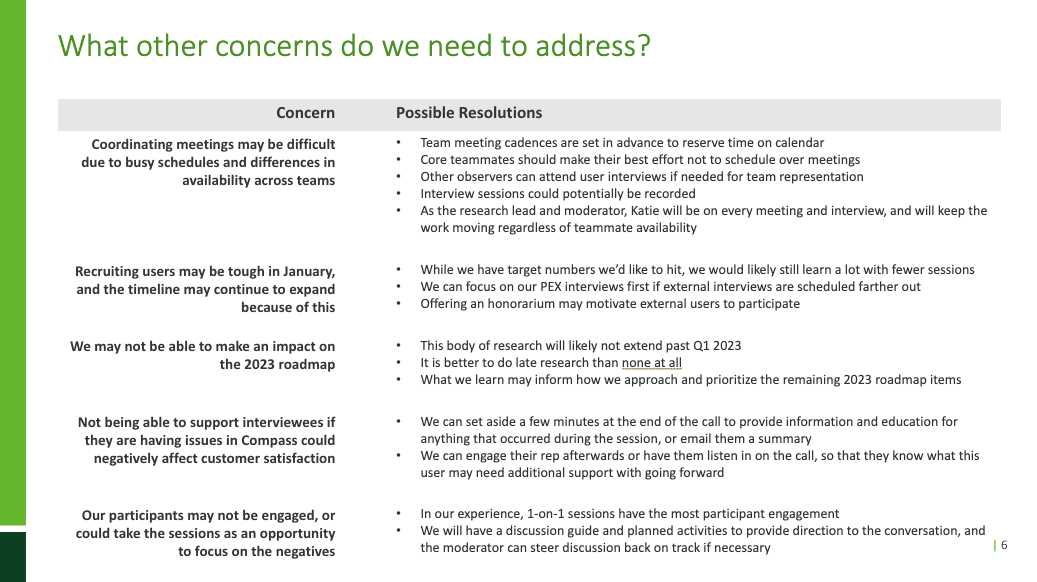
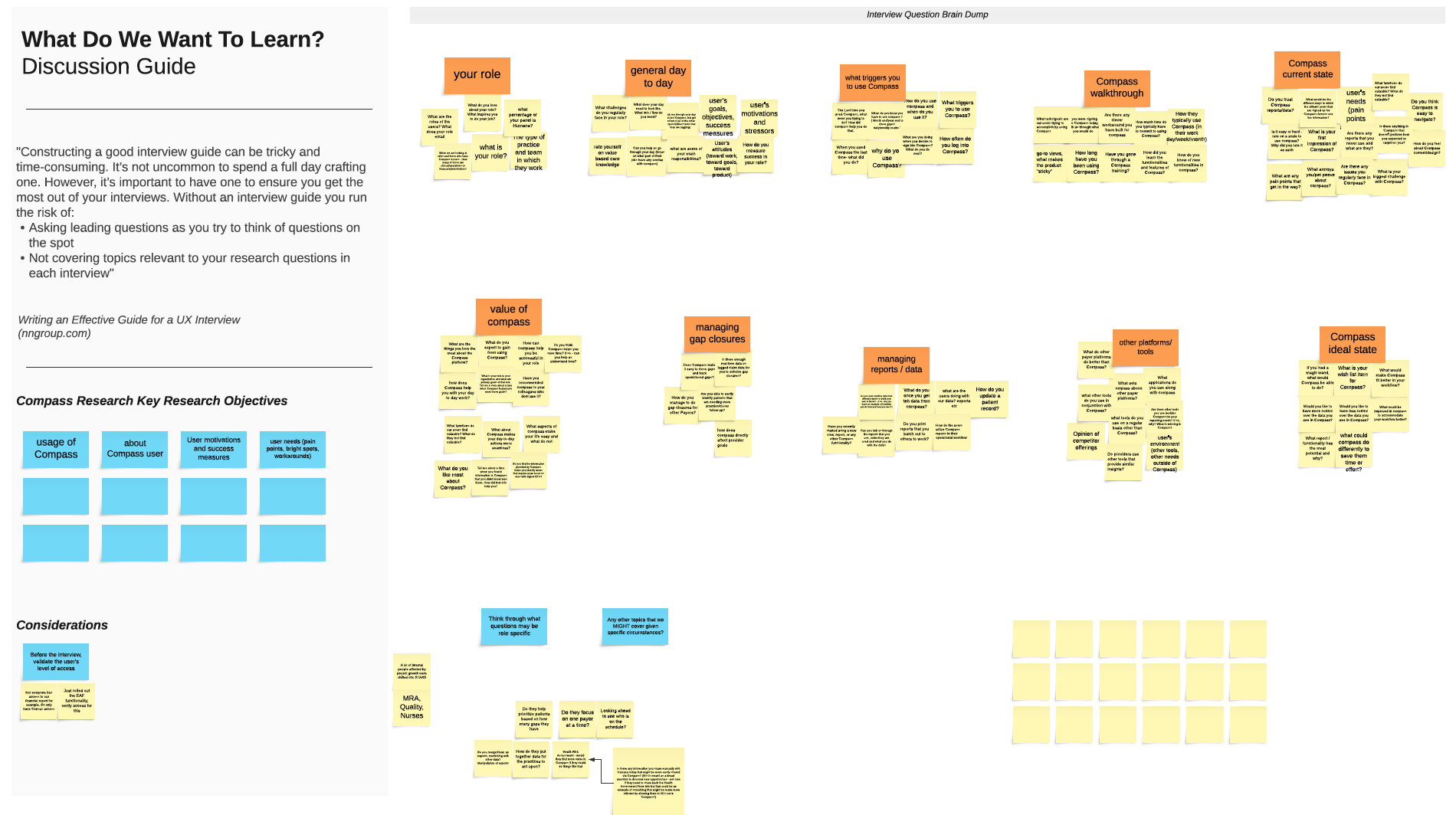
I established a small cross-functional group from the team who was willing to commit to attend a weekly working session and as many research sessions as possible. As I began to scope and plan research, I built additional buffer into my timeline to more closely involve this group in my process, to build trust and knowledge along the way via collaborative activities.
We worked together to decide on our most important recruitment criteria, and I utilized their knowledge and connections in the provider space to set up preliminary sessions with provider engagement representatives (sometimes known as PEX). PEX are internal users of the software, so this gave us some preliminary data, as well as let the team see how the sessions might look.
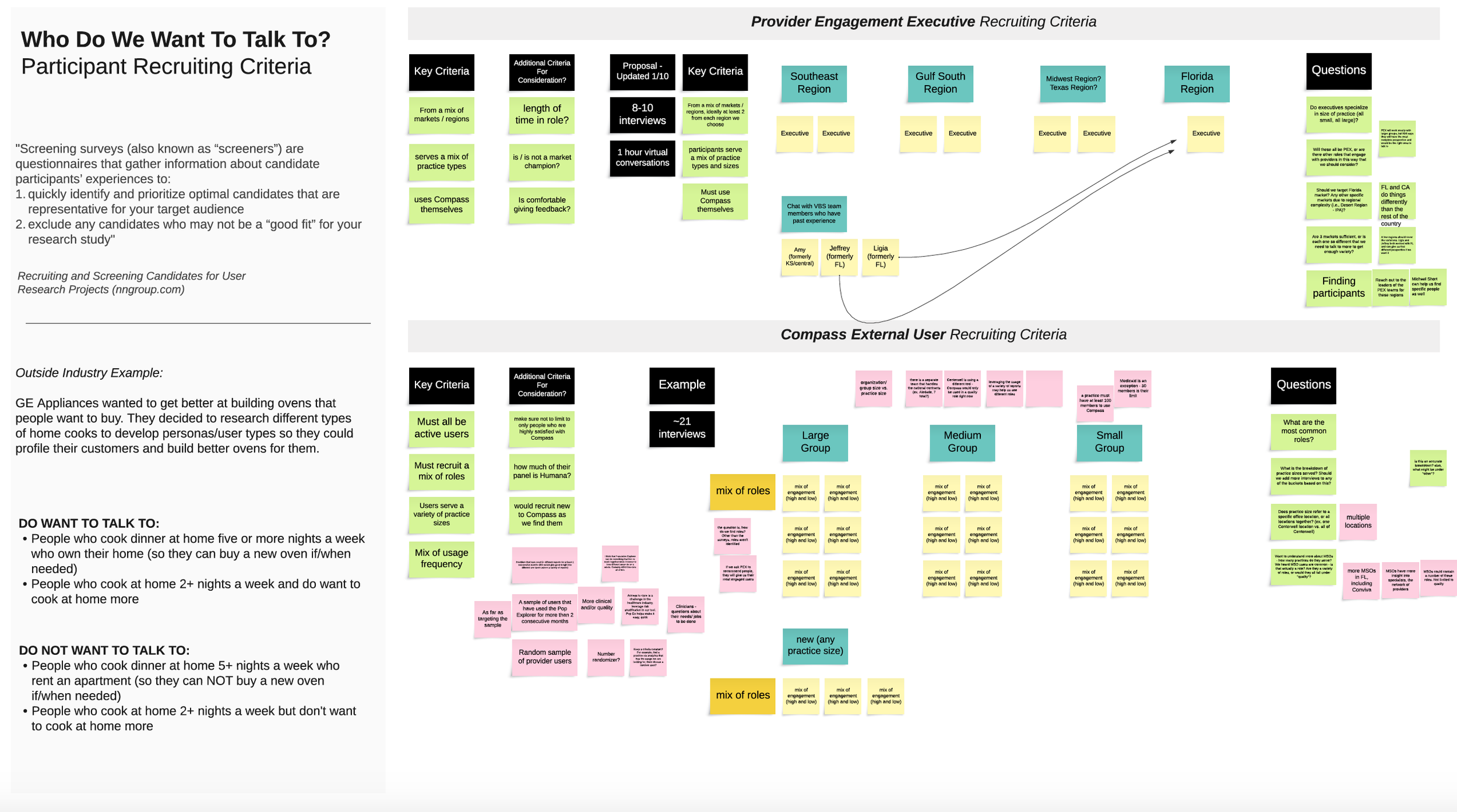
I provided information along the left of our working boards that the core team could reference to better understand the goals of the activities. We worked through the two boards above as a group over the course of several working sessions.
Recruiting providers as participants
At Humana, there are many challenges that come with doing research with healthcare providers. (Note: “providers” refers not only to patient-facing physicians, but their administrative and back-office staff as well.)
Regulation: Humana considers providers to be very high risk, and additional layers of legal and compliance review are required for research and marketing with this audience.
Availability: Many providers are very busy and have limited time for other tasks.
Recruitment: All Humana providers work with a PEX. In order to contact a provider to ask if they’d like to participate in research, we were required to speak to their PEX first.
Honorariums: Industry standard payments for this type of professional tends to be higher than the average consumer, and ranges greatly depending on whether they are a clinical role or not.
I did all outreach to PEX and potential participants, scheduled session times, and set up a 3rd-party to determine fair honorariums and distribute them.
Moderating and Analyzing
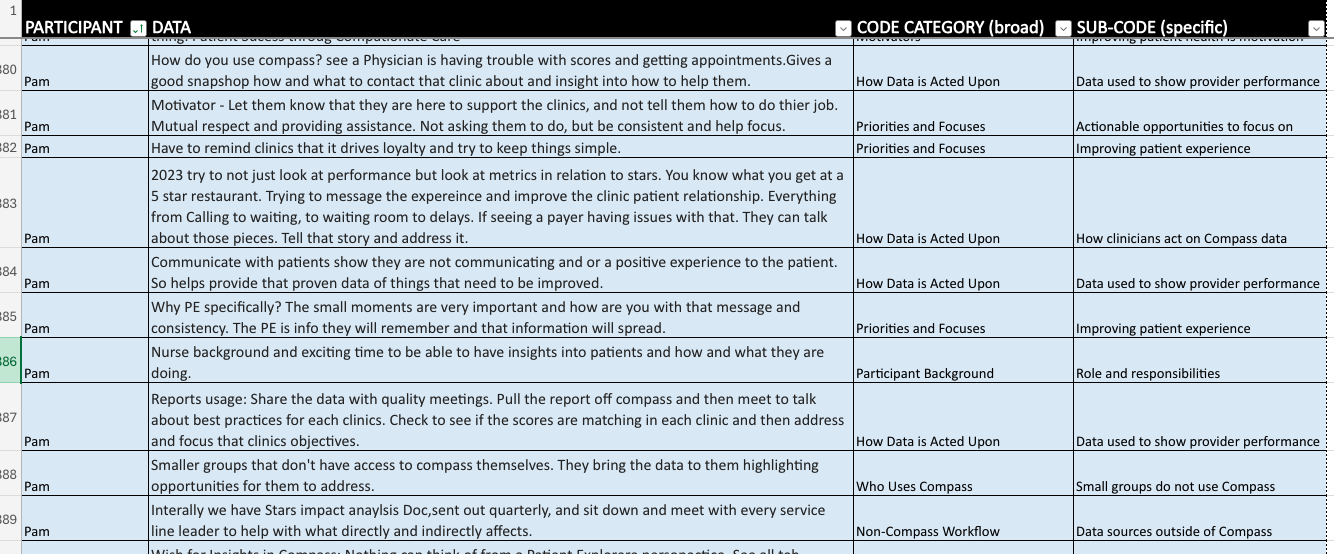
Knowing the sheer amount of notes I would have, I asked the designer to be my dedicated notetaker, and showed him the level of detail and organization that would be most helpful to me in Excel. Each participant had a tab and each note was taken in its own cell to facilitate coding later. This ended up being key to streamlined analysis later.
After individually coding each interview using a common set of codes, I combined the data to begin looking across, and began adding sub-codes for deeper anaysis.
Persona Creation
I visually mapped all participants across several key attributes, which our core team agreed upon during a working session. I compared and color-coded trends I identified. After several rounds of refinement, I determined that there were 3 distinct persona groupings across dimensions.
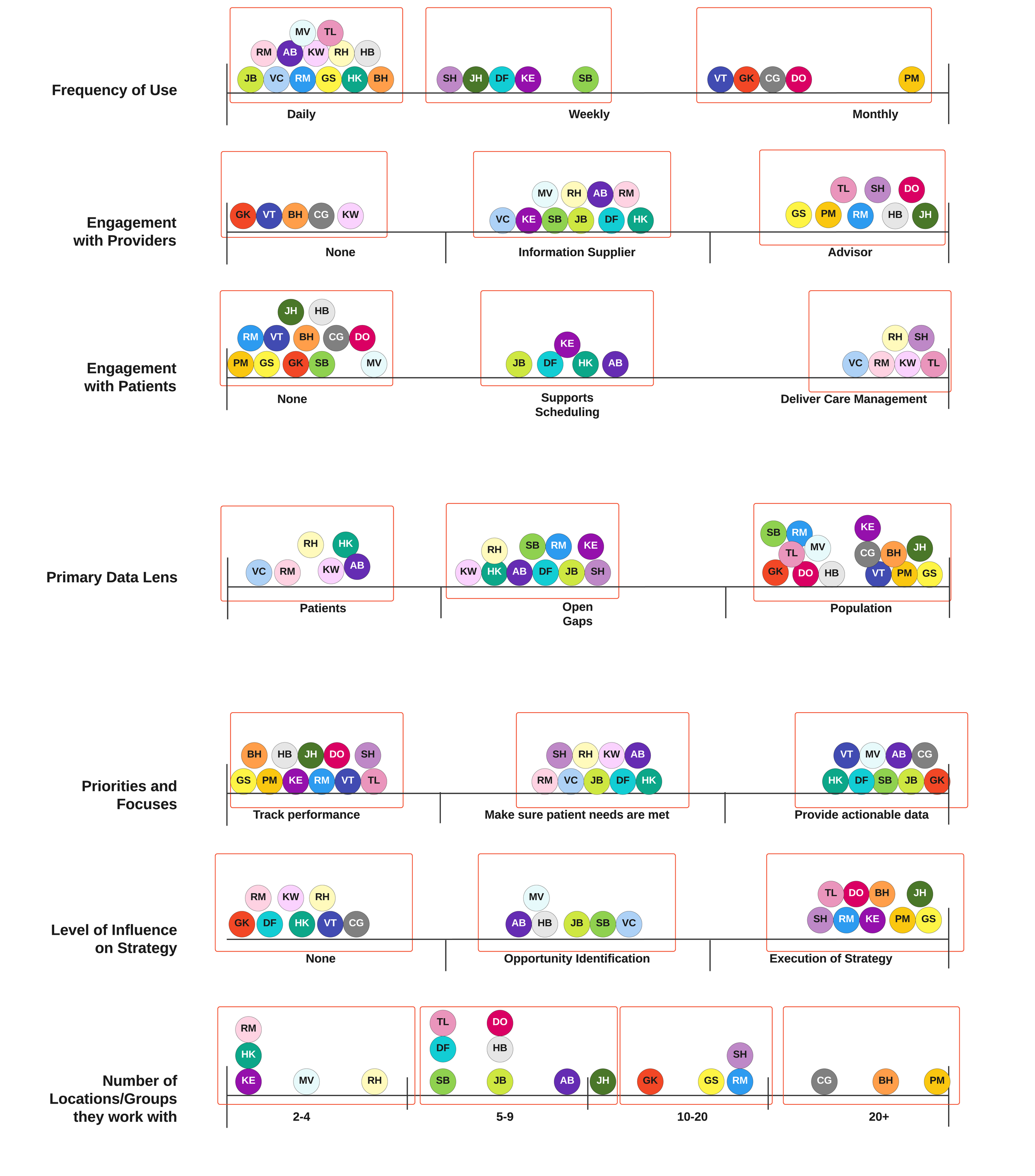
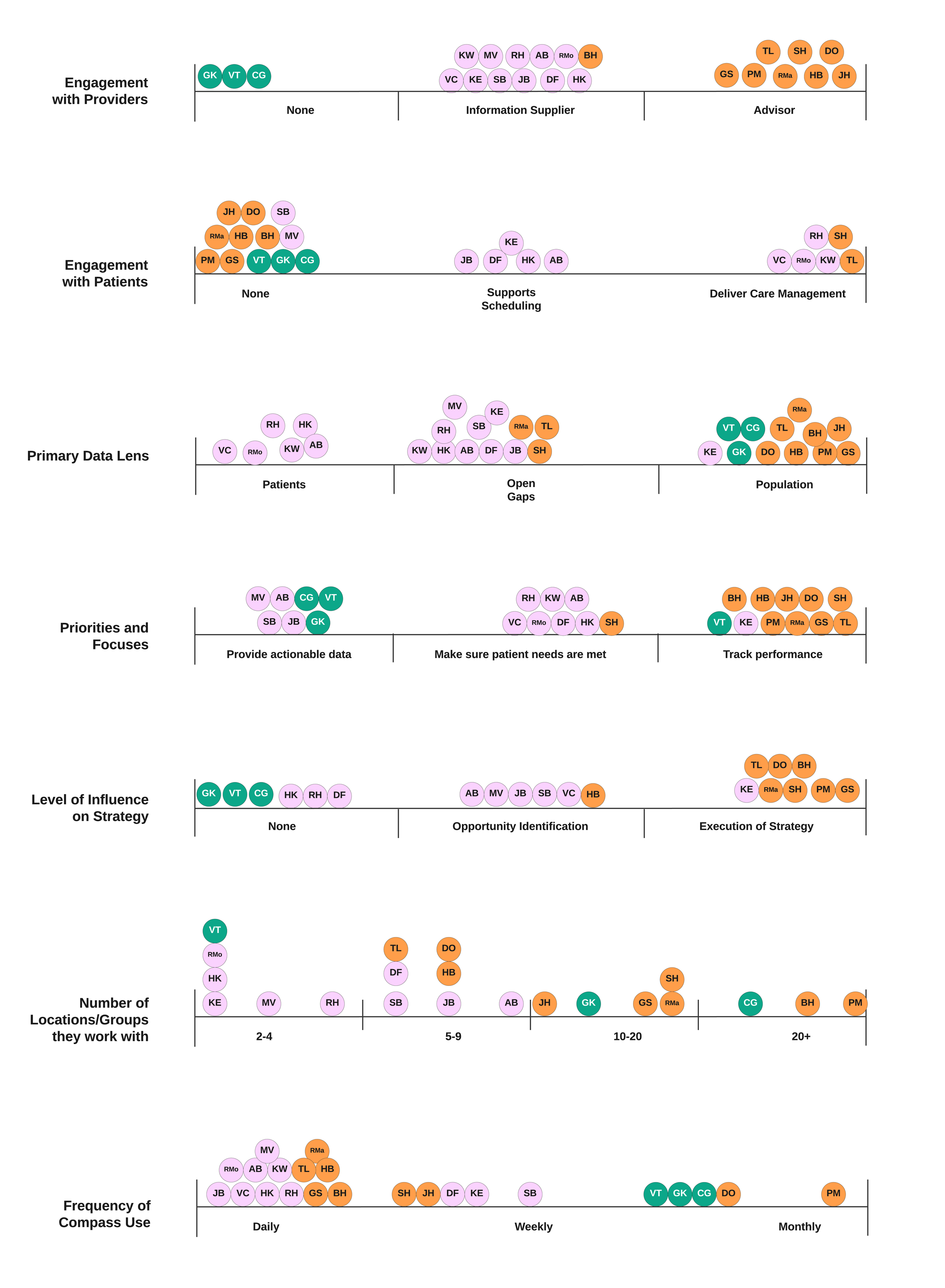
In addition to the classic persona layout, I created a simple visual of persona to show their workflow, jobs, pain points and opportunities.
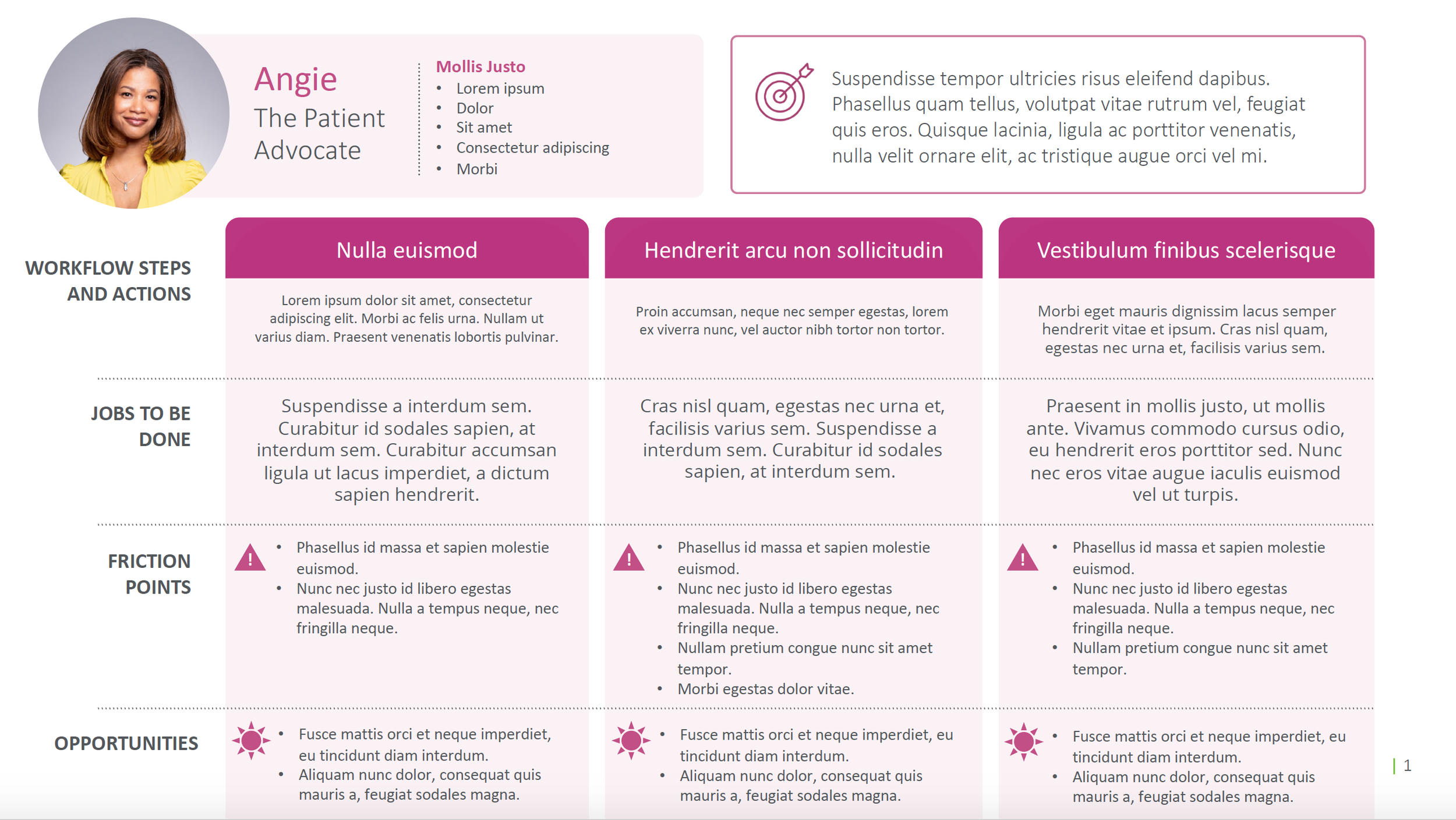
Example of 1 of 3 persona visuals - lorem ipsum is used as text filler to show the output but remove proprietary information.
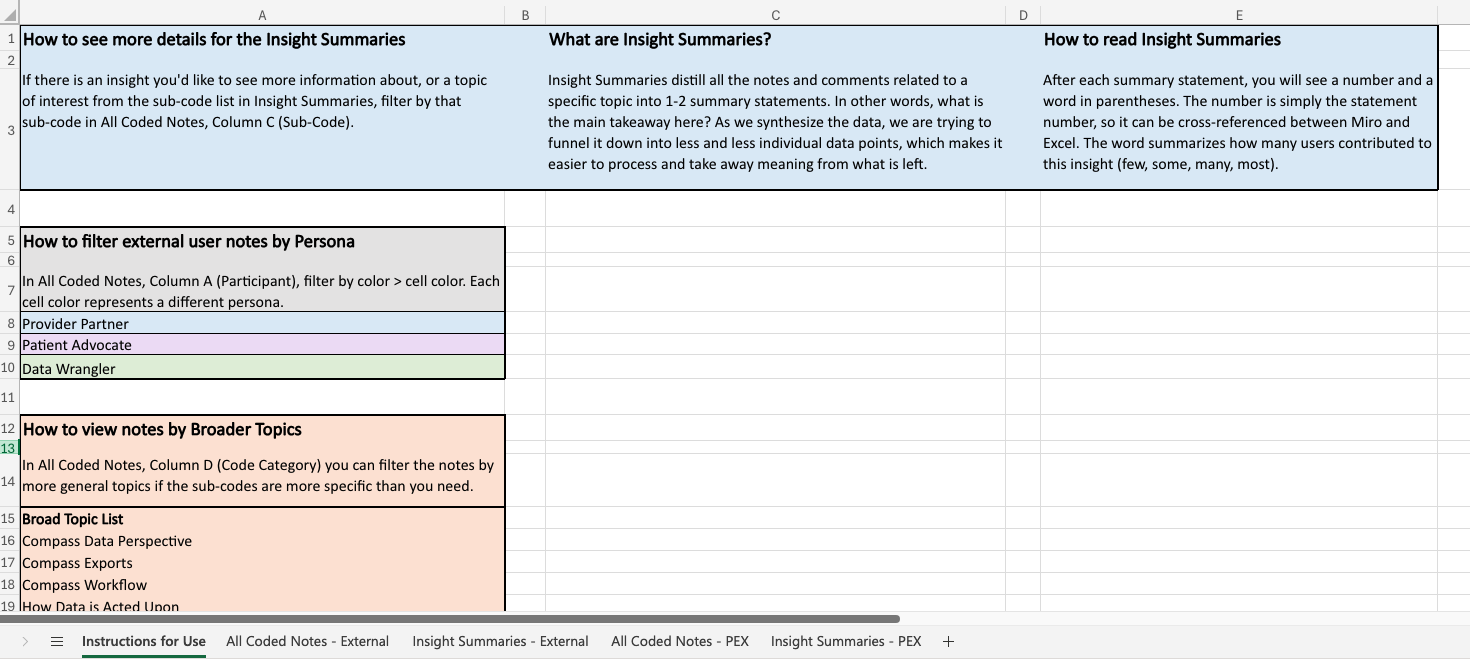
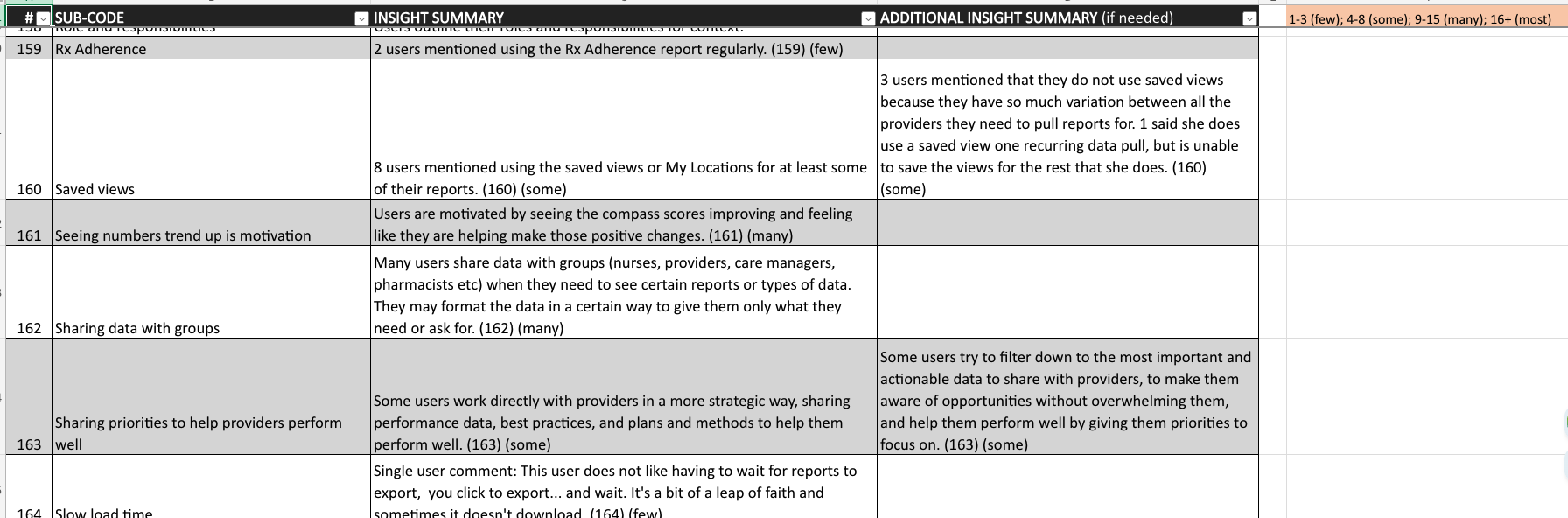
My final deliverable also included an insight summary of each sub-code, color coding by persona, and guidance for exploring the notes.
Outcome
• The team took immediate action on many of the smaller and simpler improvement opportunities.
• They created product backlogs and prioritized features that enhanced experiences for target personas.
• The team updated some of their training materials based on friction or confusion identified in this research.
Biggest Win
After just a small amount of exposure to planning activities and research observation, the team was much more willing to trust me to run this initiative.